


How Remote I/O Improves HVAC Control & Building Automation
Modern HVAC and Building Automation Systems rely on accurate field data and reliable control signals. Temperature sensors, pressure sensors, valves, fans, dampers, pumps, and other field devices all need to communicate with the automation system.
As HVAC projects become more sophisticated, system integrators need I/O solutions that are flexible, compatible with open communication protocols, and convenient to configure and maintain.
This is where a Remote I/O Module can provide significant value.
For DEKASYS, the concept of Remote I/O focuses not only on I/O signal collection and control, but also on convenient Web Configuration, Remote Management, and network-based device maintenance.
In this article, we explore how Remote I/O can improve HVAC Control and Building Automation systems and what system integrators should consider when selecting a Remote I/O solution.
What Role Does Remote I/O Play in HVAC Control?
In a typical HVAC Control system, a central controller needs to receive signals from multiple field devices and send control commands to connected equipment.
For example, an Air Handling Unit (AHU) may require different types of I/O points for:
- Supply air temperature
- Return air temperature
- Pressure monitoring
- Humidity monitoring
- Fan status
- Valve control
- Damper control
- Alarm signals
A Remote I/O Module provides the interface between these field signals and the central automation system.
Instead of designing every I/O function directly into the main controller, system integrators can use dedicated I/O modules to provide additional input and output capacity.
This makes Remote I/O particularly useful when HVAC projects require different combinations of universal inputs, digital inputs, Digital Outputs, and analog outputs.
1. Flexible I/O Expansion for HVAC Systems
One of the key benefits of Remote I/O is I/O expansion.
HVAC applications rarely have identical I/O requirements. An AHU, for example, may require a combination of temperature sensors, pressure sensors, status contacts, valves, dampers, and other devices.
A flexible I/O Expansion Module allows system integrators to select a configuration according to the actual project requirements.
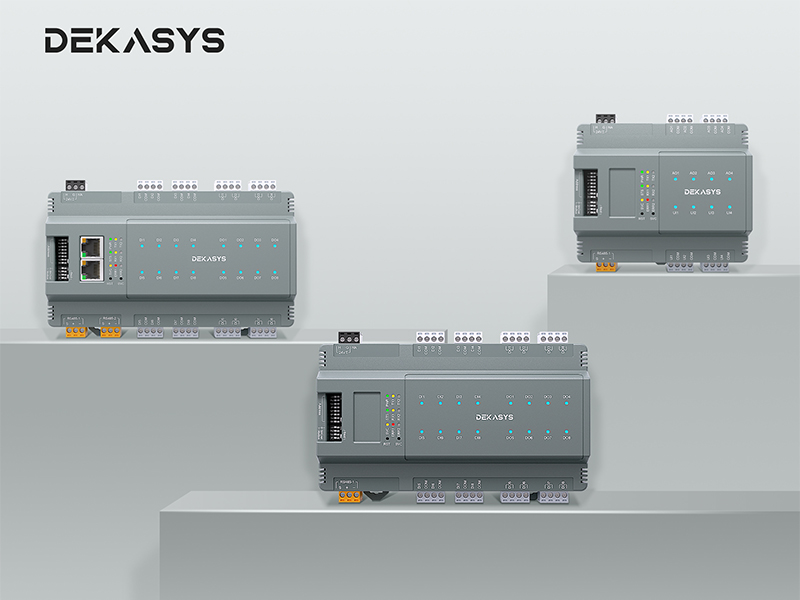
The DEKASYS SMIO Series provides both 8-point and 16-point configurations, with different combinations of UI, DI, DO, and AO.
The available configurations include models such as:
- SMIO-8UI
- SMIO-8DI
- SMIO-8DO
- SMIO-4UI4AO
- SMIO-16UI
- SMIO-16DI
- SMIO-16DO
- SMIO-8DI8DO
- SMIO-12UI4AO
This flexibility allows system integrators to match the I/O configuration to different HVAC Control requirements.
2. Web Configuration Makes Commissioning More Convenient
HVAC projects can involve many control devices and I/O modules.
During commissioning, engineers may need to configure communication parameters, device settings, and other supported functions.
A Remote I/O Module with Web Configuration can make these tasks more convenient by allowing engineers to access supported configuration functions through a web-based interface.
For DEKASYS SMIO Series modules, Web Configuration is one of the product features.
The modules also support address and baud-rate selection through hardware DIP switches, providing engineers with an additional method for device setup.
Combining local hardware configuration with network-based configuration gives system integrators greater flexibility during project commissioning.
3. Remote Management Can Simplify Maintenance
HVAC systems often operate for many years after commissioning.
During the operational lifecycle, engineers may need to modify device settings, troubleshoot communication issues, or update firmware.
A Remote I/O Module that supports network-based configuration and firmware management can make some of these tasks more convenient.
The DEKASYS SMIO Series supports firmware upgrades and configuration through RS485 or Ethernet.
This means that supported software and configuration tasks can be performed through the connected communication interface without requiring engineers to physically operate the device for every configuration change.
Remote Management does not eliminate the need for on-site service. Physical inspection, wiring work, component replacement, and other hardware-related tasks may still require engineers to visit the site.
However, the ability to perform supported configuration and firmware-related tasks remotely can help reduce unnecessary site visits and improve maintenance efficiency.
4. Open Protocols Improve Building Automation Integration
Integration is one of the most important considerations in Building Automation.
A Remote I/O Module needs to communicate with the central control system using a protocol supported by the project architecture.
The DEKASYS SMIO Series supports several open automation protocols:
- BACnet MS/TP
- BACnet/IP
- Modbus RTU
- Modbus TCP
This provides flexibility for system integrators working with different Building Automation and HVAC Control architectures.
BACnet Remote I/O
For BACnet-based Building Automation Systems, a BACnet Remote I/O Module can provide an effective interface for collecting and controlling field I/O data.
SMIO RS485 models support BACnet MS/TP, while IP models support BACnet/IP.
This makes it possible to select a suitable communication interface according to the requirements of the Building Automation project.
Modbus Remote I/O
For systems based on Modbus, the SMIO Series supports both Modbus RTU and Modbus TCP.
This allows the same product family to address different automation architectures and integration requirements.
5. Flexible I/O Types for Different HVAC Applications
Different HVAC equipment requires different types of signals.
A temperature sensor may provide a resistance or analog signal, while an equipment status signal may use a digital input. A valve or damper actuator may require an analog output.
The Remote I/O Module therefore needs to support the appropriate signal types.
The DEKASYS SMIO Series provides different I/O configurations for these requirements.
Universal Inputs
Selected SMIO models support universal inputs for:
- 0–10 V
- 0–5 V
- 4–20 mA
- 0–20 mA
- Resistance
- Temperature sensors
The relevant configurations use 12-bit ADC inputs with PGA.
Digital Inputs
Digital inputs can be used for equipment status, switches, dry contacts, and other binary signals.
Selected SMIO digital input configurations provide physical isolation.
Digital Outputs
Digital outputs can be used for switching and equipment control applications.
The SMIO series includes relay output configurations rated for 24 VAC/DC applications.
Analog Outputs
Selected SMIO models provide 0–10 V and 0–20 mA analog outputs for applications requiring variable control signals.
This range of I/O options allows system integrators to select an appropriate module for different HVAC Control applications.
6. RS485 and IP Options for Different System Architectures
Another important consideration is the communication interface.
The SMIO Series is available in both RS485 and IP communication configurations.
RS485 Remote I/O
RS485 versions support:
- BACnet MS/TP
- Modbus RTU
They can be used in automation architectures based on serial communication.
IP Remote I/O
IP versions support:
- BACnet/IP
- Modbus TCP
The IP versions also provide two Ethernet ports for daisy-chain connection.
This gives system integrators the flexibility to select an RS485 or Ethernet-based Remote I/O solution according to the requirements of the project.
7. Remote I/O Supports Different HVAC Control Applications
Because HVAC systems use different types of equipment and sensors, Remote I/O can be applied to a wide range of control and monitoring tasks.
Air Handling Unit (AHU) Control
AHU systems commonly require temperature, pressure, humidity, fan status, valve control, and damper control signals.
A suitable Remote I/O configuration can provide the required interface between these field devices and the central HVAC controller.
Chiller Plant Monitoring
Chiller plants may require multiple digital and analog signals for monitoring equipment status and operating conditions.
Remote I/O can provide additional I/O capacity for these applications.
Building Equipment Monitoring
Commercial buildings may have many equipment points distributed across different systems.
Flexible I/O configurations can help system integrators match the module selection to the actual signal requirements of each application.
8. Remote I/O Can Improve Project Scalability
HVAC and Building Automation projects may change during design, installation, and commissioning.
Additional I/O points may be required as project requirements become clearer.
Using a product family with multiple I/O configurations allows system integrators to select different combinations according to project requirements.
The DEKASYS SMIO Series provides 8-point and 16-point options and supports flexible I/O combinations. The product documentation also indicates that customized combinations can be discussed with the sales team.
This flexibility can be useful for OEM projects, system integrators, and customized Building Automation applications.
What Should You Consider When Choosing a Remote I/O Module for HVAC?
When selecting a Remote I/O Module for an HVAC Control or Building Automation project, consider the following:
I/O Requirements
Determine the required number and type of inputs and outputs.
Communication Protocol
Confirm whether the system requires BACnet MS/TP, BACnet/IP, Modbus RTU, or Modbus TCP.
Communication Interface
Determine whether an RS485 or Ethernet-based solution is appropriate for the project.
Configuration and Management
For projects with multiple devices or ongoing maintenance requirements, check whether the Remote I/O Module supports Web Configuration, firmware management, and other remote configuration functions.
Future Expansion
Consider whether additional I/O points or different I/O combinations may be required in the future.
System Compatibility
Verify compatibility with the existing BMS, BAS, HVAC controller, PLC, or other central automation equipment.
DEKASYS SMIO Series: Remote I/O for Building Automation and HVAC Control
The DEKASYS SMIO Series Remote I/O Modules are designed to provide flexible I/O expansion and communication options for Building Automation, HVAC Control, industrial automation, and monitoring applications.
The series combines:
- 8-point and 16-point configurations
- Flexible UI, DI, DO, and AO combinations
- RS485 and IP communication options
- BACnet MS/TP and BACnet/IP
- Modbus RTU and Modbus TCP
- Web Configuration
- Firmware upgrade and configuration through RS485 or Ethernet
- Hardware DIP switch configuration
- Two Ethernet ports on IP versions
- Optional physically isolated digital inputs
These features allow system integrators to select different I/O and communication configurations according to project requirements.
Conclusion
Remote I/O Modules can play an important role in modern HVAC Control and Building Automation systems.
Their value goes beyond simply providing additional I/O points. A well-designed Remote I/O solution can combine flexible I/O expansion, open communication protocols, Web Configuration, and Remote Management to support more efficient system commissioning and maintenance.
For HVAC and Building Automation projects, selecting the right combination of I/O type, point capacity, communication protocol, and configuration capabilities is essential.
The DEKASYS SMIO Series provides 8-point and 16-point configurations, RS485 and IP communication options, BACnet and Modbus support, and flexible I/O combinations for different automation requirements.
Looking for a flexible Remote I/O Module for your next HVAC Control or Building Automation project? Explore the DEKASYS SMIO Series and find the configuration that fits your application.